public.diagnostictable: diagnostic_questions
0011playbook
Is your tool Supabase-shaped?
Eight questions. Answer yes or no, and see which lessons apply to you.
-- GTM case study · Oct 2026 · 24 migrations, 0 pending
Everyone copies Supabase's playbook. I tested which parts still work.
Seven famous moves, checked against six years of GitHub, Hacker News and Wayback data, and 1,020 answers from Claude. The verdicts first, then the full 11-lesson playbook with the steps, targets and templates.
Verdicts are mine, from the evidence on this page. Each one links to the lesson with the data, the steps and when not to copy it.
It got Supabase considered overnight. Six years on, AI models still file it under the label it borrowed.
The bar moved. Your first user might be an AI agent with no account, and offline it picked SQLite 15 times out of 15.
The CEO posted 18 of Supabase's 61 biggest Hacker News stories. Nobody else posted more than 4.
29 of those 61 never say Supabase. The catch: when the question is about the standard, the standard gets the credit.
Average GitHub star lift per launch week fell every year, from 3.8x to 1.0x.
All four Firebase alternatives were open source. Only one became the default.
18 months without revenue worked on 2020 money. Check what your next investors expect first.
Lessons 1, 8, 9 and 10 cover the rest of the playbook: testing your positioning, being legible to AI, how Supabase operates, and picking an ideal customer.
Collected Oct 2026. Every number links to its query.
Eight questions. Answer yes or no, and see which lessons apply to you.
Supabase started as a fix for one CTO's chat app.
Paul Copplestone was co-founder and CTO of Nimbus for Work, an office-management startup in Singapore. When its chat feature hit Firestore's limits (too slow, queries too limited), he moved the data to Postgres and wrote an open source real-time layer for it. Developers wanted it far more than he expected. He read Hacker News about three times a day, watched the Show HNs, and saw Postgres trending. In January 2020 he and Ant Wilson spent the month interviewing developers before building Supabase.
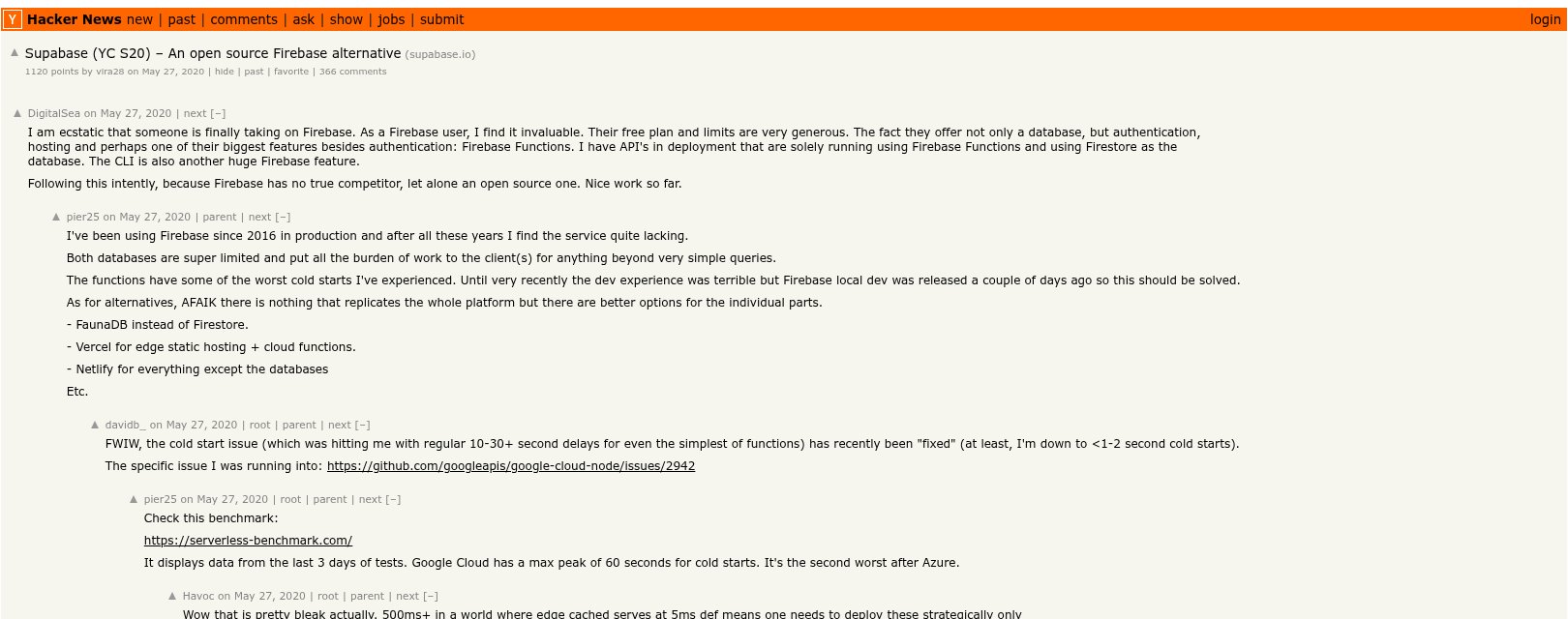
NOTICE: Hacker News thread, May 2020Firebase has no true competitor, let alone an open source one.Hacker News commenter
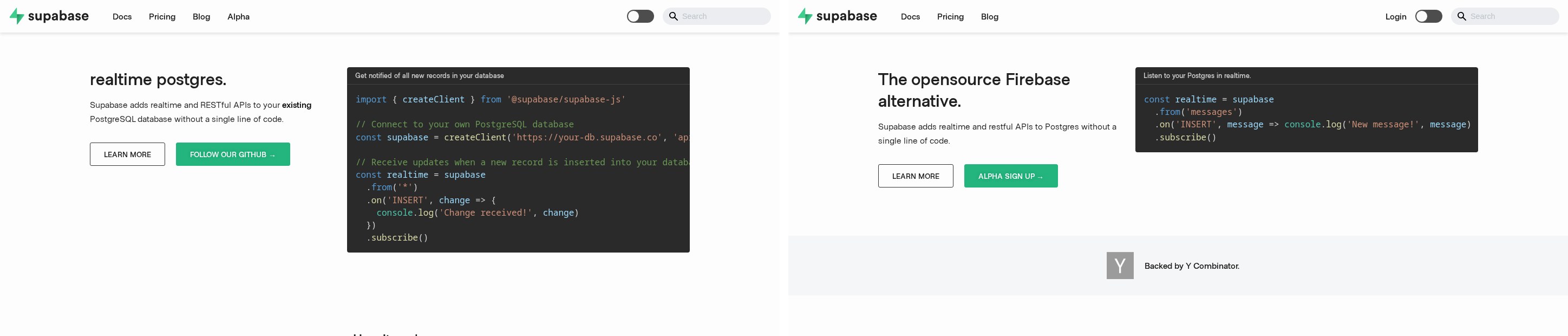
The first pitch was "real-time Postgres." Accurate. Technical. Ignored.
"The open source Firebase alternative" named a tool developers already used and the thing they feared about it: lock-in. Copplestone changed the line, and the next day an early user posted Supabase to Hacker News, where it reached the top. The two can't be separated, but Copplestone credits the positioning: "product-market fit often is just like a product-positioning fit."
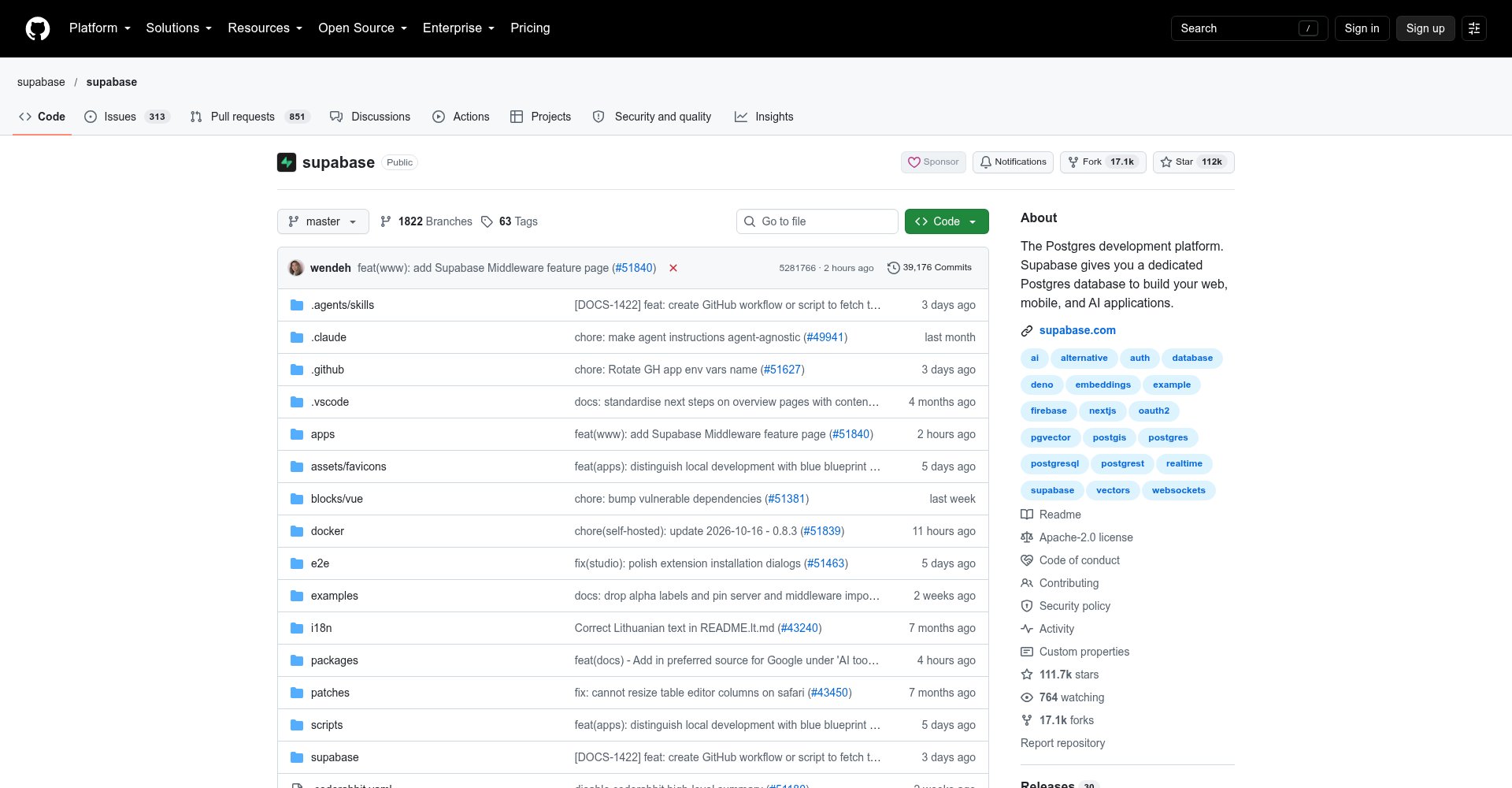
Supabase wasn't the only open source Firebase alternative. Appwrite's repo is six months older and pitched itself the same way, Nhost did too, and PocketBase went after the same developers. All four are open source, and Claude names all four. Only one became the default. The differences in the data: Supabase sat on a full Postgres database, had 61 Hacker News stories over 100 points to its rivals' 2 to 5, and is the only one Claude picks first.
One snapshot, so read it as correlation, not proof: timing, funding and teams differ too. PocketBase shows a different path: 62K stars for a single-file backend aimed at solo developers.
Borrowing a category gets you considered. Becoming the default took a standard people already trusted and years of showing up in public.
No new database. Every project is a full Postgres database.
Copplestone timed AWS himself at the start, and never said the number out loud.
Nobody owns Postgres, so everyone contributes to it. It has been the most-used database in the Stack Overflow survey every year since 2023, so every hyperscaler has to offer the best Postgres it can, which makes Postgres better still. Copplestone calls it game theory. Supabase bet on that flywheel instead of building a database of its own.
NOTICE: YC Startup School Paris, 2026No one owns Postgres, which means that everyone contributes to Postgres.Paul Copplestone, CEO
We pulled every Hacker News story with Supabase in the title or link since 2020, about 700 of them. Of the 61 that reached 100+ points, 29 never say Supabase in the headline. They teach Postgres: a language server, Postgres in the browser, full-text search. Copplestone posted 18 of the 61 himself, including two of the top three.
Supabase popularized launch weeks in dev tools; Resend, Trigger.dev and Dub now run their own. We measured each one's effect on GitHub stars against the four weeks before it, skipping the week just before. Average lift fell every year, from 3.8x in 2021 to 1.0x in 2025.
-- the detail
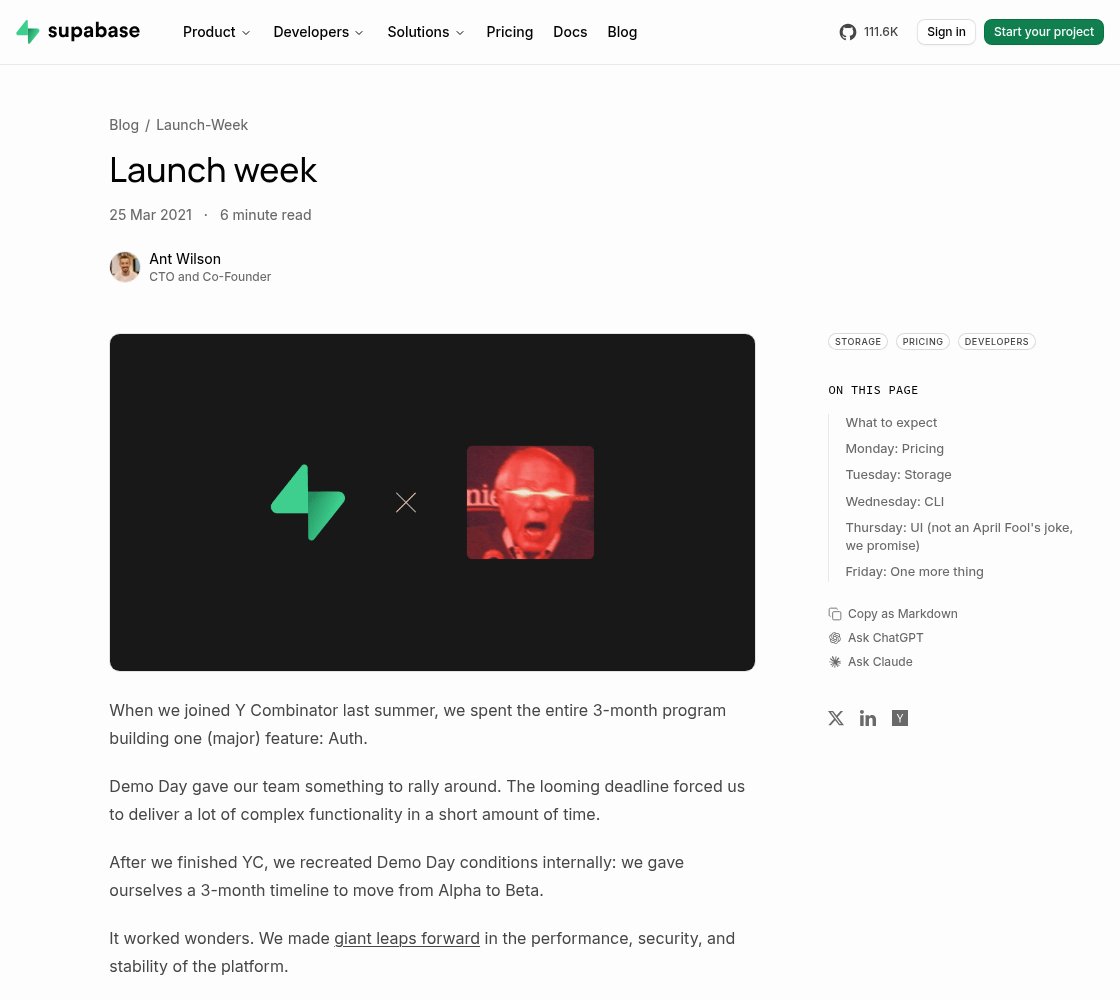
The first Launch Week started on 29 March 2021: one launch a day for five days, a way to recreate the pressure of an accelerator inside the company. Copplestone saw "these 20% bumps each time." Stars flatten as a repo gets big, so the honest reading is: the ritual kept paying; it stopped moving stars.
NOTICE: for founders copying thisLaunch weeks win attention early. At scale, they serve the users you have.From star data, 2021 to 2025
Supabase didn't pivot to AI. AI app builders and coding agents picked it, after years of being the fastest way to start a Postgres project.
In late December 2024, Bolt and Lovable were creating databases so fast that Supabase said it was getting DDoSed. The team debated building its own app builder to own the distribution, and doubled down on Supabase for Platforms instead. Copplestone says over 50 companies now build on it.
NOTICE: Series F announcement, June 2026Agents are now deploying the majority of databases on our platform.Paul Copplestone, CEO
Then the unusual part: after the holidays, with Claude Code taking off, users accelerated while activation and conversion went up too. Copplestone says they can measure 60% of databases as agent-launched and suspects the real figure is closer to 90%. In October 2026 Supabase put it at 70% of new databases.
We asked three Claude models (Opus, Sonnet and Haiku 5.5) 34 questions a developer might ask, 10 times each, then had a judge model mark the first recommendation. The study was pre-registered before the first call. Supabase wins the questions it built its name on and loses the ones it didn't: AI apps get plain Postgres, and Postgres hosting goes to Neon.
Then we gave Claude Code five apps to build in an empty folder, with no network and no accounts.
Over $1B raised since 2020. The valuation went from $2B to $10.5B in about 13 months.
Sacra estimates ARR grew from about $30M at the end of 2024 to about $170M in May 2026 (third-party estimates; Supabase doesn't disclose revenue). Copplestone says over 60% of each YC batch now builds on Supabase. In October 2026 Supabase announced it is acquiring Turso, terms undisclosed.
Next bet, per Copplestone: self-driving databases for the operate stage, so nobody wakes up at night to a database that's down. Building is easy to copy; operating is the hard part.
on why cash isn't the moatWe should not exist if AWS are so good.Paul Copplestone, on why cash isn't the moat
None of these lessons costs much to run. Every lesson, in the order you'll need it. Mark one as shipped in its block and the counter here updates.
Every schema has its warnings. These are the ones nobody puts on a slide.
HINT: make the safe path the fast path. Enable RLS on every table.
Copy these into Notion, Linear or a doc. They're MIT licensed, like everything here.
Usage metrics are company-reported. Revenue figures are third-party estimates. Star, Hacker News and homepage data is our own analysis of public sources, collected 17 Oct 2026.
Don't trust our numbers? Check them yourself. Real Postgres, in your browser.